
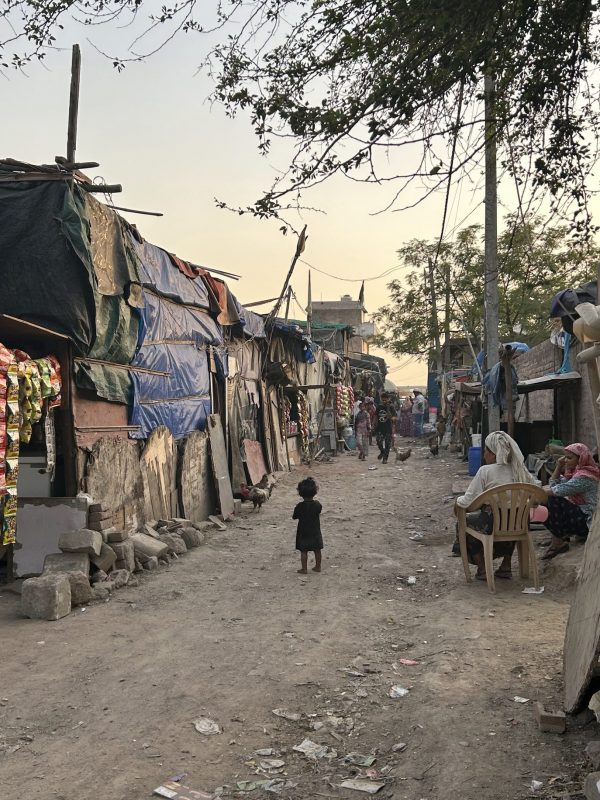
Hundreds of Rohingya refugees live under tarps, tin scraps, and spare sheets of wood they’ve found in the heart of New Delhi, India. They fight the unforgiving heat, inconsistent water supplies, and the threat of deportation to Myanmar, where they fled brutal violence. A United Nations report has recognized the Myanmar army’s campaign against the country’s Rohingya minority as genocide.
While Indian officials have expressed their support for the people of Myanmar, the Rohingya’s future is uncertain as human rights experts warn that a lack of legal protection and rights granted by the Indian government jeopardizes their safety.
Gowri Abhinanda traveled to New Delhi to gather this report for the Carolina Connection podcast: “Redefining refugee realities.”
The Rohingyas are a Muslim minority primarily from the Rakhine (Arakan) region of Myanmar. During British colonial rule, when present-day Myanmar and Bangladesh were both part of British India, there was significant migration of laborers and farmers from Bengal into Arakan. The British encouraged this movement for agriculture and administration, which gradually altered the demographic balance in parts of Rakhine and later became a major source of ethnic tension.
Myanmar’s nationalist policies and the 1982 Citizenship Law subsequently denied citizenship to most Rohingyas, leaving many stateless. Over the years, there were also allegations involving cross-border smuggling, trafficking, illegal migration, and other criminal activities linked to sections of the Rohingya population. Rising fertility rates and rapid demographic shifts further intensified fears among sections of the Buddhist population in Myanmar.
In 2016 and 2017, the Arakan Rohingya Salvation Army (ARSA) attacked police posts in Myanmar, triggering a massive military crackdown on Rohingya communities. Today, most Rohingya refugees live in camps in Cox’s Bazar in Bangladesh, while smaller groups are also found in places such as New Delhi.
To much of the Western world, the issue is viewed primarily as a humanitarian tragedy. But for many in Myanmar, the crisis also involved concerns over border security, demographic change, separatism, cultural identity, and national integration. No nation can indefinitely ignore tensions that arise when communities remain isolated, fail to assimilate, or become linked with criminal and insurgent networks.